 frant.me
One player wants to charge forward. Another needs to escape an incoming attack. Someone gets stuck behind a pillar, and suddenly the entire team is in trouble.
That’s the kind of chaos Chained Beasts is built around.
Developed and published by Featherweight Games, Chained Beasts is a cooperative gladiator roguelike that launched on October 15, 2026. It supports one to four players and combines real-time combat, physical teamwork, environmental hazards, and unpredictable character injuries.
What makes it interesting isn’t simply the unusual idea of tying players together. It’s how that restriction changes almost everything about combat.
Every movement can help or hurt a teammate. Every arena contains opportunities to defeat enemies in creative ways. And every run challenges players to survive long enough to earn their freedom.
Here are 15 reasons why Chained Beasts deserves a place on your gaming list.

1. Being Chained to Your Friends Changes Everything
Most cooperative action games allow players to move independently. You can explore one area while a teammate handles another, or retreat without worrying about where everyone else is standing.
Chained Beasts removes that freedom.
Players are physically connected by chains, meaning movement becomes a shared responsibility. Running in opposite directions can create problems, especially when enemies are approaching from several sides.
A teammate who moves too far may pull someone away from an attack. Another might accidentally drag the group toward a dangerous obstacle.
However, the chains aren’t simply there to make life difficult.
They can also become weapons. Coordinated movement allows players to trip enemies and create openings that wouldn’t exist in an ordinary action game.
That makes the central mechanic more interesting than a typical cooperative gimmick. The same object that restricts the team can help it survive.
2. Teamwork Actually Matters During Combat
Some multiplayer games claim to encourage teamwork, but skilled players can often handle most encounters without paying much attention to their companions.
Chained Beasts makes that much harder.
Because players share a physical connection, careless movement affects everyone. Even a strong player can create problems by charging into a group of enemies without considering the position of the others.
This encourages players to communicate before making risky decisions.
For example, a team might agree to move around an enemy together, using the chain to knock the opponent off balance. Another situation could require everyone to retreat in the same direction to avoid an arena hazard.
Successful teamwork isn’t necessarily about complicated strategies. Sometimes, it simply means making sure everyone knows where the group is going.
GuideFall has also explored the importance of coordination in WARDOGS, a military shooter where different player roles contribute to a shared objective.
Chained Beasts approaches teamwork differently, but the basic lesson remains familiar: individual skill matters less when the group cannot work together.
3. Gladiator Combat Encourages Creative Fighting
Chained Beasts doesn’t limit combat to repeatedly swinging a weapon until every enemy falls.
Players can use swords, other weapons, and objects found around the arena to defeat their opponents.
Throwing weapons is one option. Using nearby objects as improvised projectiles is another.
That creates opportunities for quick decisions during a fight.
If an enemy approaches while your weapon is out of reach, you might need to improvise rather than continue attacking normally.
The important part is that the arena itself becomes useful.
Players who pay attention to their surroundings can discover ways to defeat enemies without relying entirely on direct attacks.
4. Arena Hazards Make Every Fight More Dangerous
Environmental hazards are among the most entertaining parts of Chained Beasts.
The game features deadly obstacles such as spikes and snake pits, giving players additional ways to eliminate enemies.
Instead of attacking an opponent directly, a coordinated team might push or drag that enemy toward a dangerous part of the arena.
Of course, the same environment can create problems for the players.
A poorly timed movement might bring the group too close to a trap. One teammate could escape danger only to pull another into a worse position.
This creates a useful balance between opportunity and risk.
Hazards aren’t simply decorations placed around the battlefield. They encourage players to think about positioning and how the chain can be used effectively.
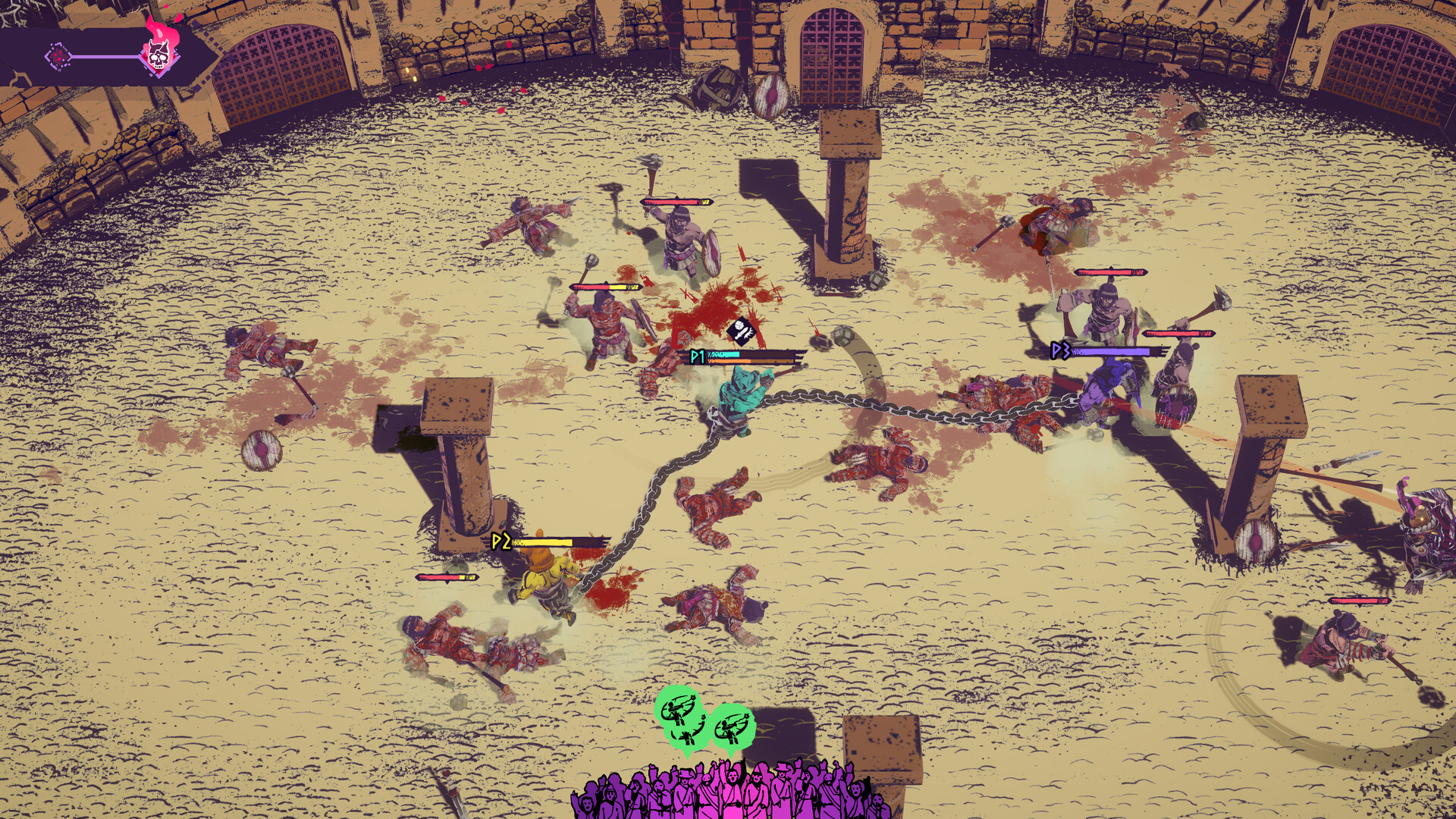
5. Every Battle Can Become Unexpectedly Funny
Chained Beasts is a violent gladiator game, but its cooperative mechanics also create opportunities for comedy.
Imagine preparing to attack a dangerous enemy, only for a teammate to run in the opposite direction and ruin your positioning.
Or picture the group trying to escape a trap while everyone disagrees about which way to move.
These situations can turn an ordinary encounter into a memorable moment.
The humour comes from the mechanics rather than scripted jokes.
That distinction matters because unexpected situations often feel more entertaining when players create them through their own decisions.
Of course, the same chaos can become frustrating when teammates repeatedly make mistakes. Players who enjoy cooperative games with unpredictable outcomes are more likely to appreciate this design.
6. The Roguelike Structure Keeps Runs Interesting
Chained Beasts uses a roguelike structure, meaning players must adapt to changing circumstances as they progress through the arena.
The full game features nine battles across three acts, with difficult bosses standing between the team and its freedom.
Each run encourages players to make decisions about their abilities, equipment, and survival.
This gives the game a different rhythm from a traditional campaign where the same character follows a fixed progression.
A successful approach in one run may not be equally effective in another.
Players need to consider the abilities they acquire and how those abilities work with their teammates.
The appeal is learning to make the most of whatever situation the game presents.
7. Character Injuries Add Another Layer of Challenge
Most action games treat injuries as a reduction in health. Lose enough health, and your character dies.
Chained Beasts takes a more unusual approach.
The game features more than 70 afflictions that can interfere with characters during their journey.
These problems can affect the team’s ability to fight effectively, creating situations where players must adapt rather than simply restore their health.
This is particularly interesting in a cooperative game.
If one player becomes less effective, the others may need to change how they approach combat.
However, a system built around disadvantages needs careful balancing. Injuries should create interesting problems without making a run feel hopeless.
The most enjoyable situations are likely to be those where the team finds a way to overcome a difficult condition through better coordination.
8. There Are Plenty of Skills to Experiment With
Chained Beasts offers more than 70 skills, giving players opportunities to develop different approaches to combat.
Some abilities can support aggressive fighting, while others may be more useful for survival or cooperation.
The challenge is deciding which skills complement the rest of the group.
Choosing an ability because it sounds powerful isn’t always the best decision.
A skill that works well for one player might contribute very little if the team is struggling with movement or survival.
Players who enjoy experimenting with builds may find this one of the strongest reasons to keep returning.
Instead of focusing only on individual damage, the game encourages players to think about how their choices affect the entire team.

9. Weapons and Equipment Give Players More Options
Surviving the arena isn’t just about learning when to attack.
Players can also purchase equipment and weapons that influence their chances of success.
According to the developer’s launch information, Chained Beasts includes more than 40 items.
This creates another set of decisions between battles.
Should a player invest in equipment that improves their own fighting ability, or choose something that helps the group survive difficult encounters?
There may not be one correct answer for every situation.
Different builds and team compositions can make certain purchases more valuable than others.
That gives the equipment system a purpose beyond simply collecting stronger weapons.
10. Eight Playable Beasts Add Variety
Chained Beasts includes eight unlockable beasts, along with variants that feature different statistics and abilities.
This gives players more than one character to experiment with.
Different beasts can encourage different approaches to combat, particularly when combined with the game’s skill and equipment systems.
For cooperative groups, character variety also creates opportunities to try new combinations.
A team might discover that one collection of abilities works particularly well together, then experiment with a completely different setup during the next run.
The value of these characters depends on how distinct they feel in practice, but having several options gives the game room for experimentation.
11. Three Arena Chapters Offer Different Environments
Chained Beasts takes players through three main chapters: Carthage, Germania, and Rome.
Each location contributes to the game’s gladiatorial theme while providing a change of scenery.
The journey begins in Carthage before moving into the frozen environment of Germania and eventually reaching Rome.
This progression helps the adventure feel like more than a series of identical battles.
Different environments also give the developers opportunities to introduce new challenges and encourage players to adjust their tactics.
The real test is whether these locations change how teams approach combat, rather than simply giving the arenas a different appearance.
For a game focused on repeated runs, meaningful environmental variety can make a substantial difference.

12. Boss Battles Test More Than Individual Skill
Boss fights are often the moments when action games demand the most from their players.
In Chained Beasts, those encounters are complicated by the fact that everyone is physically connected.
Dodging an attack isn’t always an individual decision.
If one player moves suddenly, the others may need to react immediately.
That creates situations where communication and positioning become just as important as dealing damage.
The game also introduces increasingly dangerous encounters as the team progresses through its three acts.
Boss battles should therefore provide opportunities to test everything players have learned about movement, teamwork, and survival.
13. Ten Difficulty Levels Give Players a Reason to Improve
Not everyone wants the same level of challenge from a cooperative action game.
Some players prefer a manageable experience where they can learn the mechanics with friends. Others want encounters that demand careful planning and precise execution.
Chained Beasts includes ten difficulty levels, giving experienced groups opportunities to push themselves further.
This can be particularly appealing after players become familiar with the basic combat system.
Once the team understands how to use its chains effectively, harder difficulties can encourage more deliberate decisions.
However, additional difficulty only adds value when it creates meaningful challenges.
Simply making enemies tougher is less interesting than forcing players to rethink their strategies.
The game’s combination of positioning, afflictions, and team coordination provides several ways for those challenges to become more demanding.
14. It Supports Both Solo and Cooperative Play
Although Chained Beasts is built around cooperative chaos, players aren’t required to gather a full group before entering the arena.
The game supports solo play as well as online and local cooperative modes.
That flexibility is useful for players who cannot always arrange gaming sessions with friends.
However, the experience is likely to feel quite different depending on the number of people involved.
Playing alone removes much of the unpredictable communication that makes the chained multiplayer mechanic so distinctive.
For that reason, the cooperative mode is arguably the game’s biggest attraction.
Players who enjoy coordinating with others under pressure may also be interested in GuideFall’s coverage of The Outlast Trials, where teamwork and difficult decisions play important roles in survival.
The games belong to different genres, but both can create memorable situations when a group must react to unexpected danger.
15. The Game Is Designed to Create Memorable Multiplayer Moments
Some multiplayer games are enjoyable because they offer competitive rankings or complex progression systems.
Others succeed because they create situations players want to talk about afterward.
Chained Beasts has the potential to belong to the second group.
A successful chain attack, a ridiculous accident, or an unlikely victory against a dangerous boss can become the kind of moment friends remember long after the session ends.
The game doesn’t need every encounter to unfold perfectly.
In fact, mistakes are part of what makes the concept entertaining.
The challenge is finding the right balance between amusing chaos and genuine frustration.
When players feel that their mistakes are understandable and their successes are earned, even a failed run can be enjoyable.
What Could Make Chained Beasts Frustrating?
Despite its interesting concept, Chained Beasts won’t be the right choice for every player.
The biggest concern is the same mechanic that makes the game distinctive: being chained together.
Players who prefer complete control over their movement may find the restrictions irritating, particularly when a teammate makes repeated mistakes.
The game’s chaotic combat can also become difficult to follow when several enemies, chains, weapons, and hazards occupy the same area.
Another consideration is its roguelike structure.
Players who dislike repeating encounters or starting new runs after failure may not enjoy the progression as much as those who appreciate learning through repeated attempts.
Finally, the experience depends partly on the people you’re playing with.
A coordinated group may enjoy developing strategies, while a less patient team could become frustrated when mistakes affect everyone.
These aren’t necessarily flaws, but they’re important things to consider before buying.
Who Should Play Chained Beasts?
Chained Beasts is particularly appealing to players who enjoy cooperative games that demand communication and quick decisions.
- Co-op fans: Players looking for something different to enjoy with friends.
- Roguelike enthusiasts: Anyone who enjoys repeated runs, changing builds, and difficult encounters.
- Action game players: Those who appreciate real-time combat and creative ways to defeat enemies.
- Groups that enjoy chaotic games: Friends who can laugh when a plan goes wrong.
- Challenge seekers: Players interested in mastering difficult combat mechanics across multiple difficulty levels.
Frequently Asked Questions About Chained Beasts
Is Chained Beasts worth playing?
Chained Beasts is worth considering if you enjoy cooperative action games, roguelike progression, and unpredictable multiplayer situations. Its chained movement mechanic gives teamwork a more direct role in combat than many traditional co-op games.
Can you play Chained Beasts alone?
Yes. Chained Beasts supports solo play, although its cooperative mechanics are a major part of the game’s appeal.
How many players can play Chained Beasts?
Chained Beasts supports one to four players, including online and local cooperative options.
When was Chained Beasts released?
Chained Beasts launched on October 15, 2026.
Who developed Chained Beasts?
Chained Beasts was developed and published by Featherweight Games, an Australian independent game studio.
What platforms is Chained Beasts available on?
The game launched for PC through Steam, PlayStation 5, Xbox Series X|S, and Nintendo Switch. It was also announced for Game Pass on Xbox and Windows PC.
Does Chained Beasts have character progression?
Yes. Players can unlock different beasts, choose skills, and purchase equipment. The game also features multiple difficulty levels and a variety of afflictions that influence each run.
Final Verdict: Is Chained Beasts Worth Playing?
Chained Beasts stands out because it turns teamwork into a physical part of combat rather than treating cooperation as an optional advantage.
Being connected by chains changes how players move, fight, and react to danger. The mechanic creates opportunities for creative strategies, but it also makes mistakes harder to ignore.
That combination is what makes the game interesting.
Its roguelike progression, different playable beasts, environmental hazards, and demanding boss encounters provide reasons to keep experimenting after the first few runs.
At the same time, the game asks players to accept a certain amount of frustration. Not every plan will work, and sometimes the biggest obstacle will be a teammate moving in the wrong direction.
For players who enjoy cooperative action games where communication matters and unexpected situations are part of the fun, Chained Beasts offers a distinctive experience.
It may not be the best choice for someone who prefers complete independence during combat, but for a group of friends willing to work together and laugh at their mistakes, it looks like a particularly entertaining way to spend an evening.




Comments 0
Share your thoughts about this article.